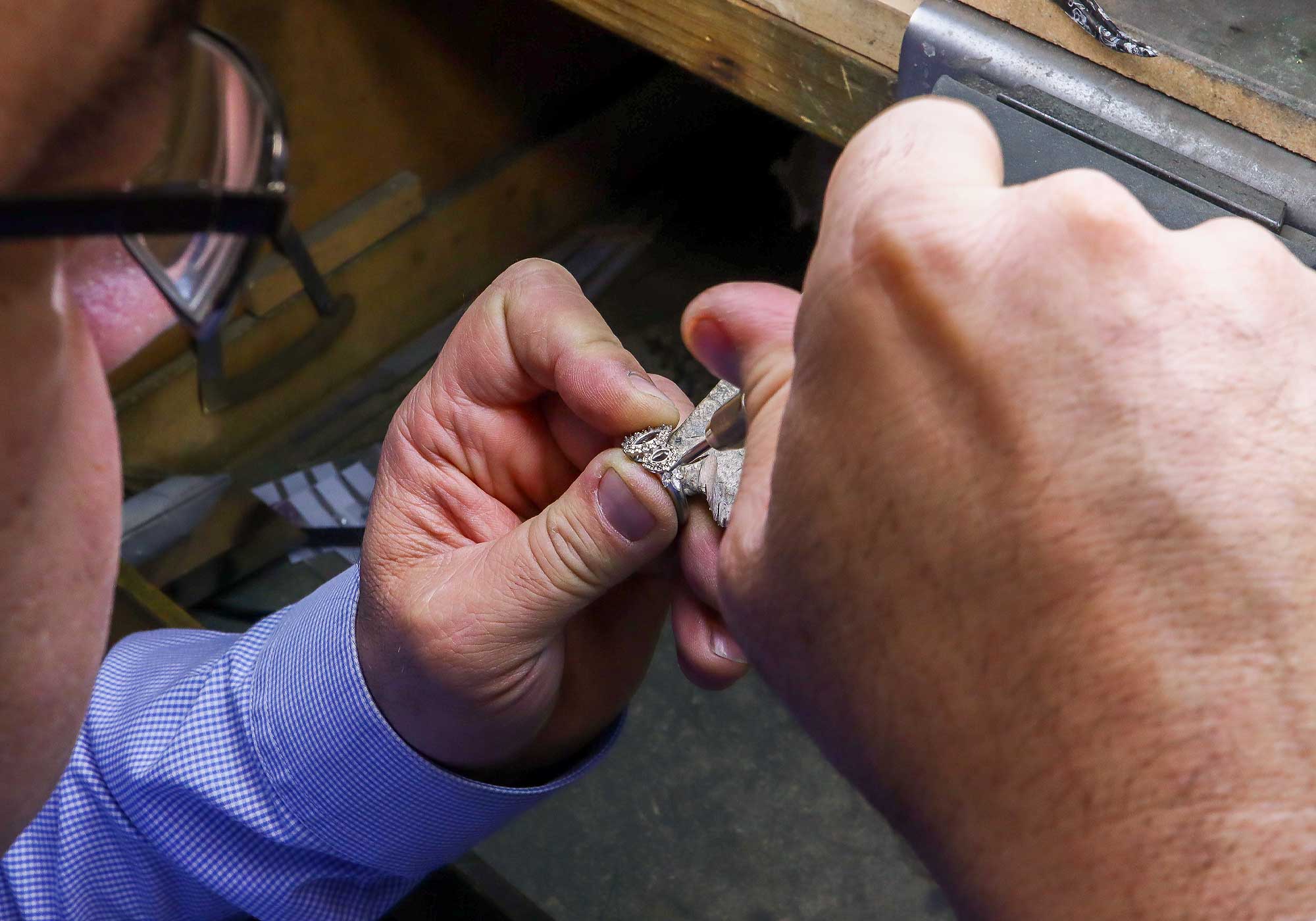

Most of us have had it happen. A favourite ring gets too tight, a stone starts to rattle, a chain snaps, or a claw catches on a jumper. You take it in expecting a quick, cheap fix, and the quote surprises you.
It's a fair reaction. Most repairs look small from the outside. But there's a lot happening at the bench that you never see, and knowing what goes into it makes the price make sense.
Every repair starts with an inspection
Whatever the job, a good jeweller begins the same way:
- Cleaning the piece and inspecting every stone and claw under magnification
- Checking the metal for thin spots, cracks or old repairs
- Working out how to protect the stones from heat, since some can crack or change colour under a torch
This step often finds problems you didn't know you had, like a worn claw that's one knock away from losing a diamond.
What goes into the most common repairs
Claw re-tipping
The claws holding your stone wear down over years of everyday wear. Once they get thin, the stone is at real risk of falling out. Re-tipping means building new metal onto the tip of each worn claw, then shaping, filing and polishing it so it sits snugly over the stone again.
Each claw is its own small, precise job. A six-claw engagement ring can mean six separate re-tips, all done right next to a diamond that must not be damaged.
Stone tightening
A loose stone is a warning sign. Tightening involves carefully pushing the metal back over the stone with setting tools, a fraction of a millimetre at a time. Too little pressure and the stone stays loose. Too much and it can chip or crack.
Every setting style is different. Claw, bezel, channel and pavé settings all need their own approach. And if the claws are too worn, tightening won't hold, and the piece needs re-tipping first.
Stone replacement
Replacing a lost or damaged stone starts with finding the right one. It has to match the original's size, shape, cut and colour, often down to a fraction of a millimetre. Then the setting may need its seats re-cut so the new stone sits perfectly level, before it's set and secured.
Sourcing alone can take time, especially for unusual sizes or coloured stones.
Chain repairs
Chains look like the simplest repair of all, but they can be some of the fiddliest. Many links are finer than a millimetre. The jeweller has to join the broken link without fusing it to its neighbours, keep the chain flexible, and make the join strong enough to last. Hollow, rope and box chains are even trickier.
Done well, you can't find the break. Done poorly, it snaps again in the same spot or leaves a stiff, visible lump.
Ring resizing
To resize a ring, the band is cut, and new gold is added (to go up a size) or removed (to go down). The join is soldered with metal matched to your ring's carat and colour. The shank is reshaped to be perfectly round, then filed and sanded until the join disappears. Rings set with stones around the band need extra care, as the stones can loosen or crack when the shank is stretched or heated.
The finishing work most people don't know about
Almost every repair ends with a full re-polish. Soldering, filing and reshaping leave marks, and heat dulls the metal. So once the repair itself is done, the whole piece gets polished back to a smooth, even shine through several stages. It's not just the repaired spot. The entire piece has to match.
White gold needs one more step. Most white gold is plated with rhodium, a bright, white precious metal that gives it that crisp finish. Any repair work strips or damages that plating, so the piece has to be re-rhodiumed. That means deep cleaning, electroplating, and finishing again.
Rhodium is one of the most expensive precious metals in the world, often costing more than gold. So re-plating isn't a small add-on. It's a real part of the cost, and skipping it leaves your ring looking yellowish and patchy.
You're paying for years of skill
Jewellers in Australia typically train through a four-year apprenticeship, and the real skill keeps building for years after that. Knowing how much heat a sapphire can handle, how to re-tip a claw so it holds a diamond securely, or how to repair a fine chain without leaving a lump. That knowledge is what keeps your piece safe.
A good repair is often invisible. That's exactly the point.
Precious metal costs real money
Re-tipping, resizing and chain repairs all mean adding real precious metal, and gold prices have climbed sharply in recent years. Solder, rhodium and platinum all carry a cost too. Using cheaper materials is possible, but it shows up later as colour mismatches, weak joins, or plating that wears off in weeks.
Equipment and responsibility
Quality repairs rely on specialist tools: laser welders for delicate work near stones, setting tools, ultrasonic cleaners, polishing motors, magnification, and precise measuring gear. On top of that, a jeweller is taking responsibility for something valuable and often irreplaceable. Insurance, care, and a secure workshop are all part of that.
Why some repairs are so cheap
Very low prices usually mean something got skipped. Stones weren't checked, a claw was bent over instead of re-tipped, a lower-quality solder was used, the join wasn't finished properly, or the piece wasn't replated. It might look fine walking out the door, but a weak repair can fail later, and a lost diamond costs far more than the repair ever would have.
A cheap repair often ends up being the expensive one.
What you should expect from a good repair
- A proper inspection and an honest assessment before any work starts
- A clear quote upfront, with no surprises
- Materials that match your piece
- A finish so clean you can't tell it was repaired
- Someone who'll tell you if a piece needs more work than you asked for, like worn claws that could lose a stone
Repairs at Vahé Jewellery
At our Rowville showroom, every repair is treated with the same care as a new custom piece. Whether it's re-tipping, tightening or replacing a stone, fixing a chain or resizing a ring, we'll inspect your jewellery, explain what it needs and why, and give you a clear quote before we start.
If something's worn, broken, loose, or just not fitting right, bring it in. We'd love to help you keep wearing the pieces that matter to you.